What's driving demand and shortages in Q2?
For organisations designing and manufacturing electronic products, the supply chain landscape remains a critical area to monitor.
This update outlines the key factors influencing component availability, pricing and lead times, as well as our recommendations relating to what these developments may mean for projects scheduled through 2026 and into 2027.
What changes are we seeing?
Across the electronics supply chain, we continue to see pricing adjustments and tightening availability.
Some market commentary may overstate short‑term concerns, but the underlying structural pressures are genuine and continuing to build. These pressures are not driven by a single issue, but stem from a combination of global influences that are reshaping how components and materials are sourced.
Understanding these drivers is essential for informed planning and risk management.
What's driving current market conditions?
Geopolitical instability remains a major influence on global supply chains. Ongoing uncertainty continues to affect trade policy, tariffs and the movement of goods. At the same time, the shift toward regionalised manufacturing is reshaping supply networks and introducing new constraints.
These factors don’t always create immediate disruption, but they do manifest over time through pricing changes, availability challenges and increased variability in lead times.
Energy pricing and raw material availability are also becoming more influential. Semiconductor production is highly energy‑intensive and fluctuations in global energy markets are now directly impacting manufacturing costs.
Material availability is tightening too. Key inputs including industrial gases and specialist materials used in semiconductor fabrication are under sustained pressure. This is contributing to tighter allocation and continued upward pricing movement.
Memory and semiconductor supply
Board‑level memory remains one of the most constrained areas of the market. Across DRAM and NAND, major manufacturers are effectively sold out through 2026, with limited visibility into 2027.
Many customers are receiving only partial allocation, and lead times continue to extend with demand rising across AI infrastructure, automotive electronics and industrial systems. Long‑term agreements are increasingly required to secure supply, reducing flexibility across the wider market.
This reflects a structural imbalance between supply and demand, not a short‑term fluctuation.

Component pricing snapshot
Across many semiconductor categories, we are seeing price increases typically between 10% and 25%, with higher movement in the most constrained areas.
Recent examples include; Texas Instruments who have announced pricing adjustments effective April 2026, NXP where increases across multiple product families have been seen, and Micron, SK Hynix and Samsung with ongoing allocation pressure driving memory pricing upward.
While the exact impact varies by part and manufacturer, the overall direction is clear. Costs are rising and supply flexibility is reducing.
PCB materials and upstream supply
The PCB supply chain is also experiencing significant upstream pressure.
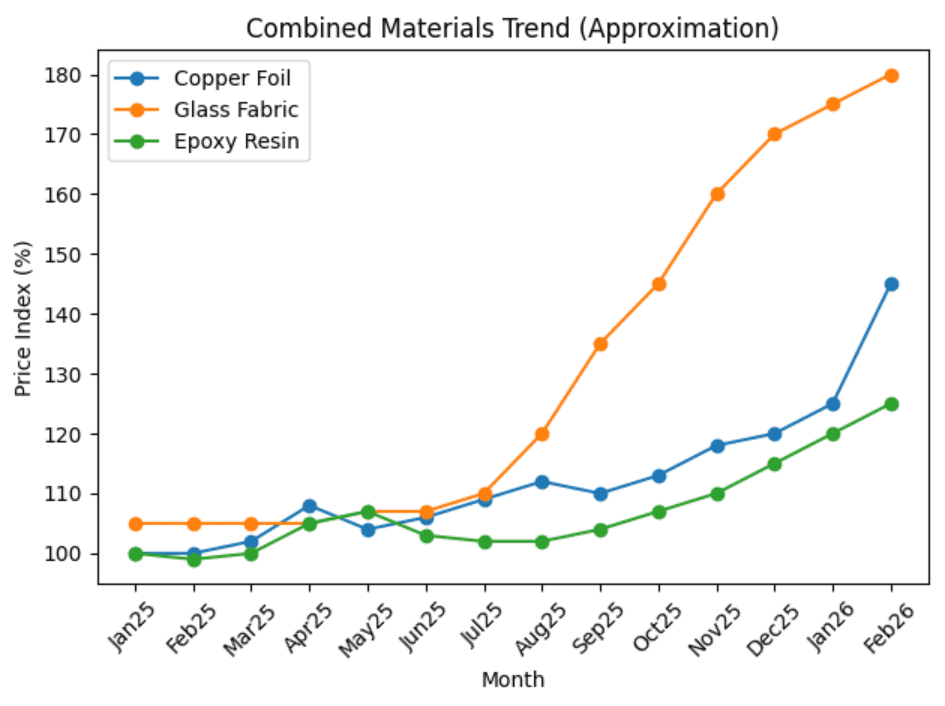
Materials such as glass fibre, resin and copper are becoming more constrained. Demand for higher performance materials, particularly for AI‑related applications, is reducing the availability of standard grades.
Geopolitical instability is affecting resin supply, while copper pricing remains elevated due to sustained global demand and increased processing costs.
These pressures are feeding directly into PCB manufacturing, influencing both cost and lead time.
Market signals and short term noise
Recent pricing announcements reflect broader market conditions.
At the same time, there has been an increase in urgent market alert messaging. While some of this reflects genuine movement within the market, it is important to recognise that not all urgency indicates a true shortage.
In some cases, these communications reflect short-term market activity or positioning within a volatile environment. A measured approach, supported by a clear understanding of underlying conditions, remains essential.
What this means for our customers
We are seeing rising costs across components, materials and logistics, alongside increasing variability in lead times and allocation. It is important to recognise that pricing is only one part of the challenge. The greater risk often comes from production disruption caused by shortages or extended lead times.
Our recommendations
To maintain continuity and reduce the risk of disruption, we are strongly encouraging our customers to adopt a forward-planning approach.
This includes reviewing upcoming builds earlier than usual, identifying components with potential supply risk and securing critical parts ahead of demand peaks.
Proactive planning is proving to be the most effective way to manage exposure and maintain production schedules.
How can Garner Osborne help?
We are working closely with our customers to navigate these conditions and minimise risk.
Our team can support you by reviewing BOMs to identify potential exposure, advising on sourcing strategies and supporting forward planning.
Where appropriate, we can also procure and hold components on your behalf, helping to secure supply, manage pricing volatility and maintain continuity across your projects.
If you would like to discuss your requirements, please get in touch with our team today who will be happy to assist.